
Blog
Websites, Apps, SEO, Ads Why Doing Them Separately Is Killing Business Growth


Many companies start by outsourcing their digital presence.
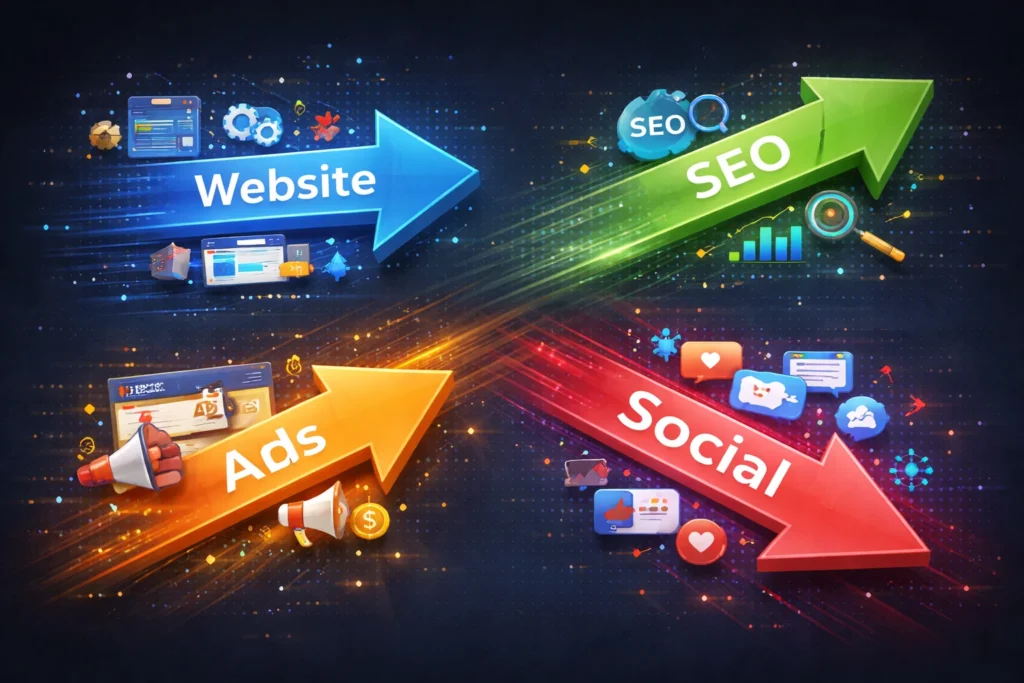
One agency builds the website, another manages SEO, while paid ads and social media follow separate paths.
In parallel, some businesses even develop their mobile applications without any connection to the core system.

At first glance, everything looks active.
Projects move forward, teams deliver reports, and budgets continue to flow.
Yet behind this activity, growth often becomes fragmented, expensive, and unclear.
This is where most companies misunderstand integrated digital systems.
What holds most companies back is not service quality, but the absence of a system designed to connect everything together.
In today’s competitive market, especially for growing businesses in Dubai, digital success is no longer about doing more.
It is about connecting everything into a single, scalable digital business system.
The Service Trap: When Everything Works Alone but Nothing Works Together
One of the most common mistakes growing businesses make is buying individual services instead of building a connected system.
While each service often performs well on its own, the overall structure remains disconnected.
A professional-looking website, positive SEO indicators, active advertising campaigns, and consistent social media content can all exist at the same time.
However, problems emerge once these efforts operate independently.
Across multiple platforms, data becomes scattered, teams lose a shared reference point, and visibility into performance decreases.
A professional-looking website, positive SEO indicators, active advertising campaigns, and consistent social media content can all coexist.
Why Websites, Apps, SEO, and Ads Are Not a System
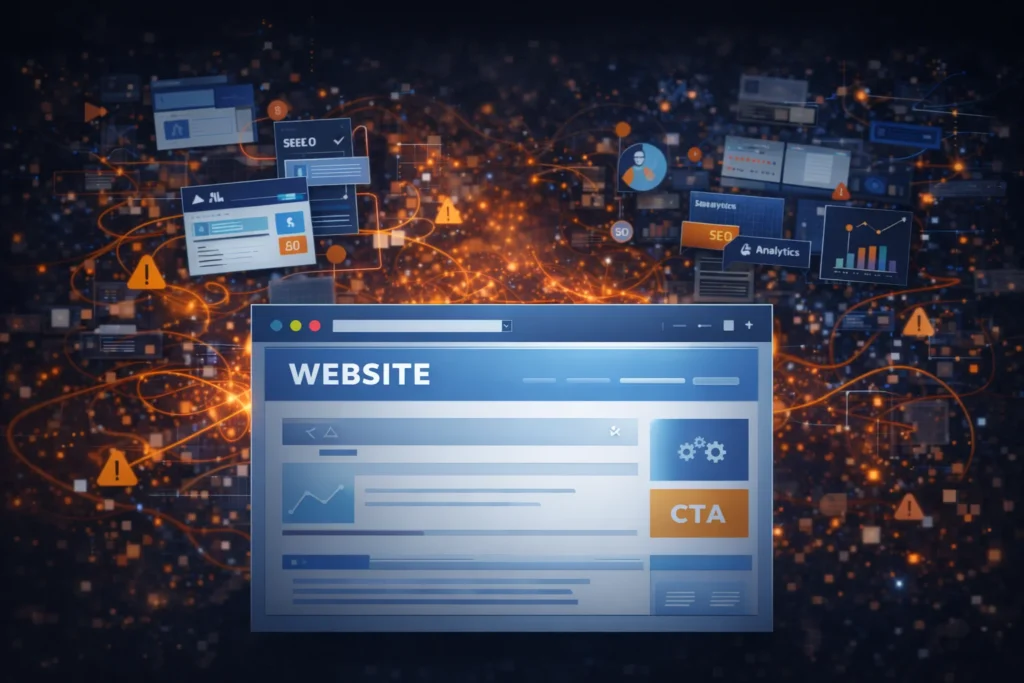
Websites, applications, SEO, and advertising are often treated as independent solutions rather than parts of a unified system.
Each component is assigned a specific role, evaluated separately, and typically managed by a different provider.
However, the challenge does not lie in the effectiveness of these individual elements.
The real issue is that they were never designed to operate together as one cohesive system.
Without integration, a website becomes a static presentation instead of a foundation for custom web and application development that supports real business operations.
When data remains disconnected, applications turn into isolated tools with limited strategic value.
As a result, SEO drives traffic without conversion when it is not part of an SEO strategy aligned with business goals and connected to the core system.
Meanwhile, advertising creates activity without real insight unless it is part of performance-driven digital marketing connected to operations and analytics.
Over time, this type of fragmentation reduces visibility across the business.
Marketing, operations, and results slowly drift further apart.
What remains is constant movement but not real progress.
When data flows through one connected system, AI-powered decision support becomes possible instead of relying on assumptions and fragmented reports.
What an Integrated Digital Business System Actually Is
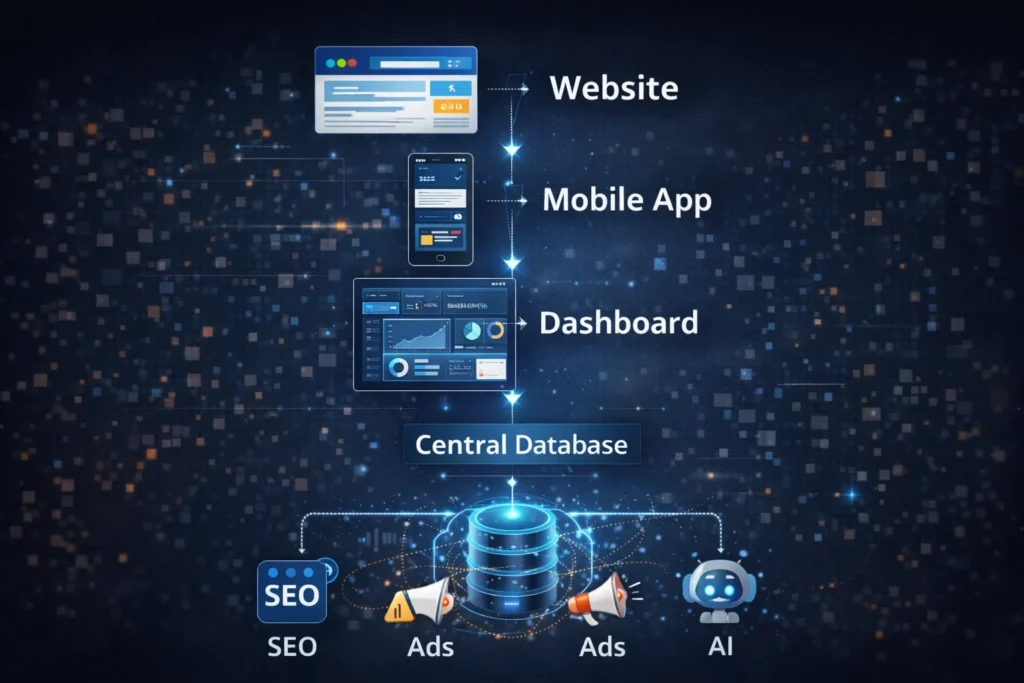
An integrated digital business system is not a collection of services.
It is a single, connected structure designed to support the entire business.
In this model, every digital component works as part of one system:
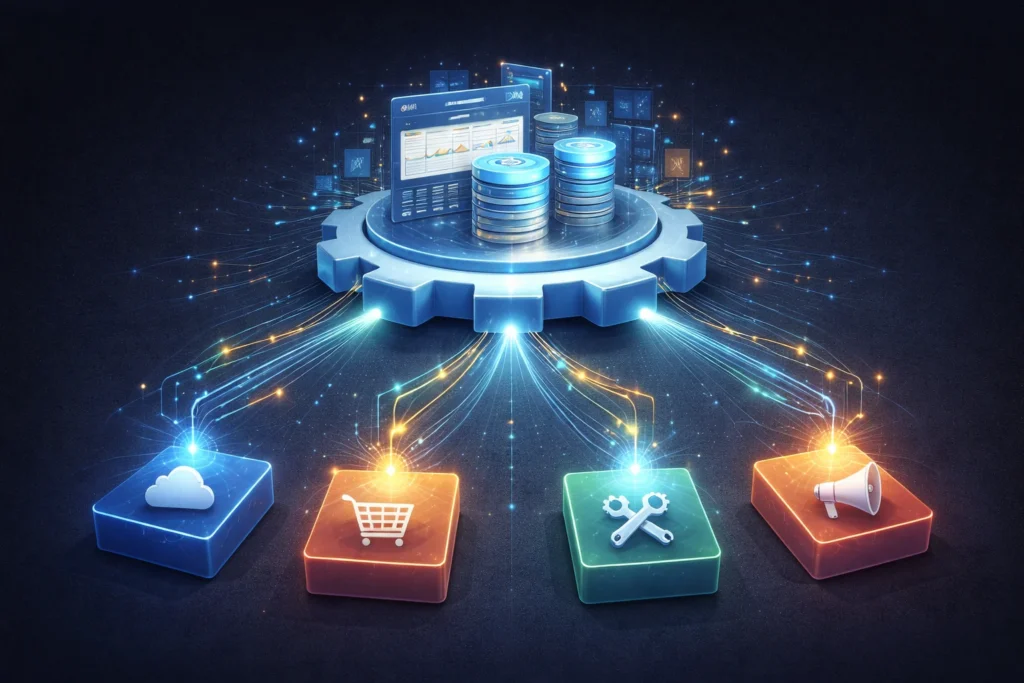
The website, mobile application, dashboards, databases, marketing channels, and analytics are all connected.
Data flows through one central source.
Actions in one area immediately reflect across the system.
Instead of managing tools, the business manages outcomes.
Instead of switching between platforms, teams work from a unified environment.
And instead of guessing, decisions are made based on complete, real-time data.
This is what transforms digital activity into scalable business growth.
How Integrated Digital Systems Change the Way Businesses Operate

When digital systems are integrated, operations stop reacting and start aligning.
Instead of working in isolation, marketing connects directly to the core system.
SEO, paid ads, and social media feed into one unified flow.
As a result, teams track leads accurately, measure behavior clearly, and monitor performance across the entire business.
At the same time, administration becomes more structured.
Dashboards replace spreadsheets, processes become measurable, and teams gain visibility instead of complexity.
The result is not just better performance.
It is better control.
When Growth Becomes Fragmented, Expensive, and Hard to Control

Many businesses reach a point where growth feels heavy instead of exciting.
- More traffic requires more support.
- More leads create more pressure.
- More tools introduce more confusion.
At this stage, the problem is rarely marketing or demand.
The real issue is that growth is happening without a system designed to handle it.
Without integration, every new channel adds friction.
Costs increase.
Visibility decreases.
And decision-making slows down precisely when speed matters most.
Why Growing Businesses in Dubai Need Integrated Systems

Dubai is a fast-moving and highly competitive market.
Opportunities appear quickly, but mistakes are costly.
For growing businesses, operating with fragmented digital services is no longer sustainable.
Speed without structure leads to waste.
Growth without clarity leads to instability.
An integrated digital business system provides a foundation that can scale.
It allows companies to move quickly without losing control.
As a result, the system supports growth through structure rather than chaos.
One System. One Partner. One Source of Truth

Building and maintaining an integrated digital system requires more than technical execution.
It requires strategic alignment.
When businesses work with multiple disconnected providers, responsibility becomes fragmented.
In contrast, working with a single partner focused on systems creates clear accountability.
A unified system builds consistency, a dedicated partner ensures continuity, and a single source of truth enables leaders to make confident decisions.
Conclusion
Digital growth does not fail because companies lack tools.
Instead, it fails when those tools were never designed to work together as one system.
Websites, applications, SEO, advertising, branding, and analytics only create value when they are part of one system.
Without integration, effort multiplies but progress slows.
For businesses that want clarity, control, and scalable growth, the answer is not more services.
It is an integrated digital business system.
Start by evaluating how your digital components connect, not how they perform individually.
According to McKinsey, companies that align digital transformation with core business systems are significantly more likely to achieve sustainable growth.
As a result, when systems align, growth becomes sustainable rather than stressful.