
Blog
Mobile App Development Cost in the UAE: Flutter Explained (2026 Guide)

Last updated: November 2026
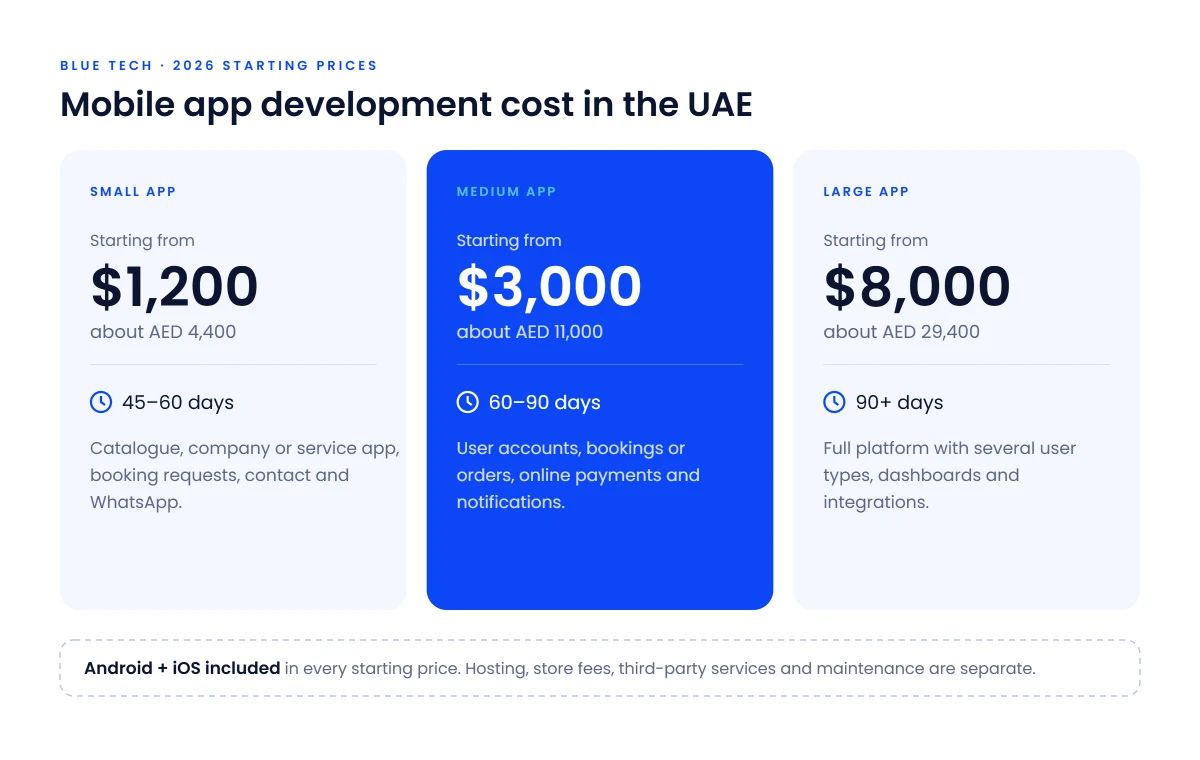
Quick answer: In 2026, Blue Tech builds Flutter mobile apps in the UAE from about AED 4,400 (USD 1,200) for a small app, AED 11,000 (USD 3,000) for a medium app and AED 29,400 (USD 8,000) for a large app. Small apps take 45 to 60 days, medium apps 60 to 90 days and large apps 90 days or more.
If you ask five agencies in Dubai what an app costs, you will get five very different numbers. Some published 2026 price guides start a basic app at around AED 18,000 to 30,000, while others quote six figures before they know what the app needs to do.
The honest answer is that the price depends on what the app has to do, how many people will use it, and what it needs to connect to. This guide explains the real price ranges we work with at Blue Tech, why we build most apps with Flutter, and what to check before you sign a quote.
How much does mobile app development cost in the UAE in 2026?
| App size | Blue Tech starting price | Typical timeline | Typical examples |
|---|---|---|---|
| Small app | From USD 1,200 (about AED 4,400) | 45 to 60 days | Catalogue, company or service app, simple booking request, contact and WhatsApp |
| Medium app | From USD 3,000 (about AED 11,000) | 60 to 90 days | User accounts, bookings or orders, online payments, notifications, admin panel |
| Large app | From USD 8,000 (about AED 29,400) | 90 days or more | Full platform, several user types (customers, drivers, staff), dashboards, integrations |
Blue Tech starting prices (2026)
- Mobile apps (Flutter): small from USD 1,200 (about AED 4,400), medium from USD 3,000 (about AED 11,000), large from USD 8,000 (about AED 29,400)
- WordPress business websites: from AED 1,500
The final quote depends on pages, features and integrations. Get a quote on WhatsApp
Every starting price includes both an Android and an iOS app for the agreed scope. AED amounts are approximate, at USD 1 = AED 3.6725. Timelines are indicative and depend on the final scope, testing and app store review, so they are not a guaranteed store publishing date.
Not included in the starting price: hosting, App Store and Google Play account fees, third-party services (maps, SMS, payment gateway fees), ongoing maintenance and applicable taxes. Design depth, the backend and admin panel, and store submission depend on each project and are confirmed in your quote.
What makes an app small, medium or large?
Small apps
A small app does a few things well. It shows your products or services, lets people contact you or send a booking request, and pulls content from a simple admin area. Good examples are a restaurant menu app, a clinic information app or a company app for existing customers.
Medium apps
A medium app has users who log in and do something: place an order, book a time slot, pay online or track a request. It usually needs a backend and an admin panel where your team manages orders, bookings and users, plus push notifications.
Large apps
A large app is a platform. It has more than one type of user, for example customers, drivers and restaurant staff in a delivery app, with separate apps or dashboards for each. It often connects to payment gateways, maps, SMS or WhatsApp, an ERP or accounting system, and needs to handle many users at once.
What is Flutter, and why does it lower the cost?
Flutter is an open-source framework from Google for building mobile apps. Its main advantage is simple: one codebase runs on both iPhone and Android.
With native development, you usually build and maintain two separate apps, one in Swift for iOS and one in Kotlin for Android. With Flutter, most of the work is done once. That means:
- Lower build cost, because most features are written once instead of twice.
- Faster launch, since both versions are ready at the same time.
- Easier updates, because a change or fix goes to both platforms together.
- Consistent design, with the same look and behaviour on every phone.
Flutter apps feel smooth and native for most business uses: e-commerce, bookings, delivery, education, service and loyalty apps. Native development still makes sense when an app depends heavily on advanced device features, complex 3D or AR, or very specific hardware integrations. We will tell you if your app falls into that group.
What drives the price up or down?
Number of features. Every screen and workflow takes design, development and testing time. A list of “nice to have” features is the most common reason a budget doubles.
Backend and admin panel. Most apps need a server, a database and a dashboard for your team. Sometimes we can reuse your existing website or system, which lowers the cost.
Integrations. Payment gateways, maps and tracking, SMS, WhatsApp, delivery companies or accounting software each add work, and some charge their own fees.
Design. A clean design based on proven patterns costs less than fully custom animations and illustrations.
User types. One app for customers is simpler than a customer app, a driver app and an admin dashboard working together.
Arabic and English. A bilingual app with right-to-left support needs extra design and testing, but for many UAE businesses it is worth it.
Real example: HML home maintenance platform
HML is a home maintenance platform in the UAE. Blue Tech built the full digital system: a customer app, a technician app, a central admin dashboard and the company website, as well as the brand identity.
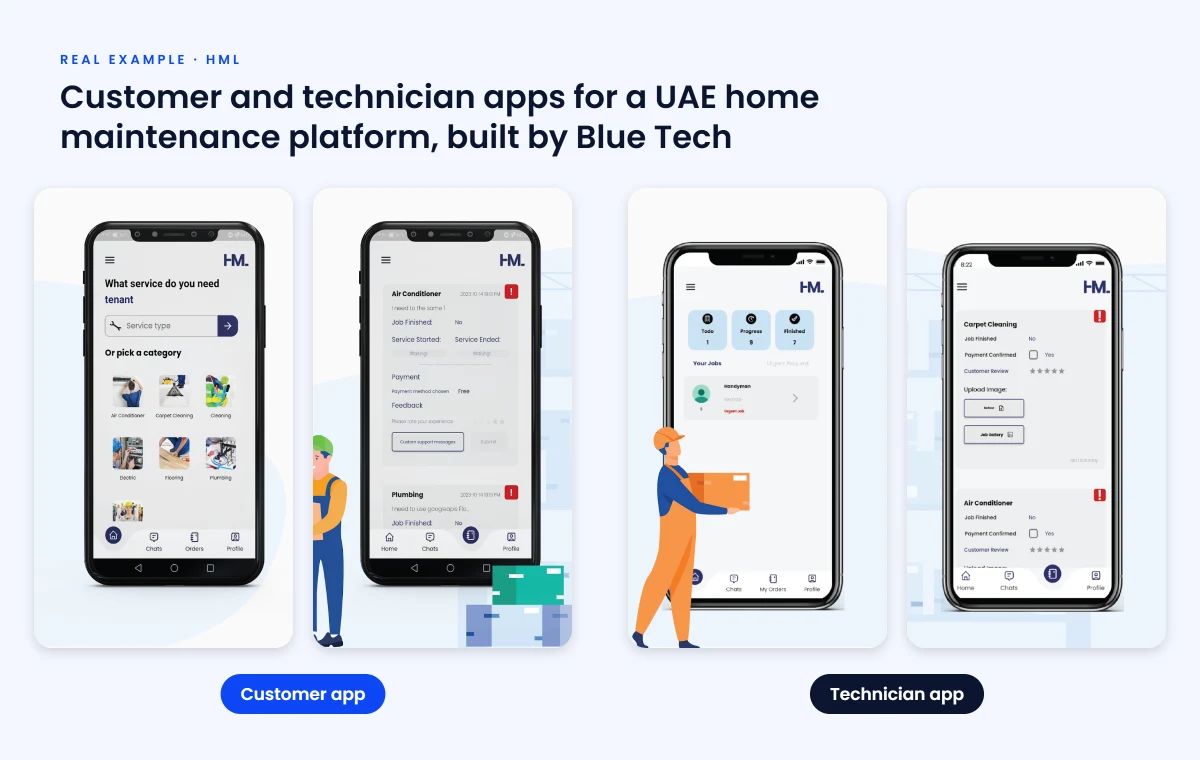
- Customer app: customers book a service, choose their location, schedule a time and pay online.
- Technician app: technicians receive job assignments, update the job status and get real-time notifications.
- Admin dashboard: the HML team manages technicians, tracks orders, and reviews reports and analytics in one place.
According to the HML case study on Blue Tech’s website, the platform helped HML achieve a 60% faster response time, with fewer manual errors and booking conflicts.
You can see the live apps here: customer app on Google Play, customer app on the App Store and technician app on Google Play.
HML is a good example of a large app: several user types, payments, scheduling and a dashboard working together. If your idea needs a web platform as well as an app, see our custom web applications service.
What costs do people forget?
The development quote is not the whole budget. Plan for these as well:
- App store accounts: Apple charges USD 99 per year for a developer account, and Google Play charges a one-time USD 25.
- Server and hosting: a monthly cost that grows with the number of users.
- Third-party services: maps, SMS, email, payment gateway fees and cloud storage.
- Maintenance: iOS and Android release new versions every year, and apps need updates to keep working smoothly.
- Content and marketing: an app needs a launch plan, store listing and promotion to get downloads.
Ask any agency to list these in writing before you start.
How can you keep the app cost under control?
- Start with a focused first version. Launch with the features customers need on day one, then add the rest based on real feedback.
- Write down what the app must do. A one-page list of features and user types gives you more accurate quotes.
- Reuse what you already have. If you have a website or system, the app can often connect to it instead of starting from zero.
- Choose Flutter unless you have a clear reason not to. One codebase saves money now and on every future update.
- Agree on milestones. Pay in stages linked to working features, not dates.
What should you ask before you sign?
- Is the price for both iPhone and Android?
- Does it include the backend and admin panel?
- Who owns the source code when the project is finished?
- Who publishes the app to the App Store and Google Play, and under whose account?
- What happens after launch: is there support or a maintenance plan?
- Which third-party fees will I pay separately?
Frequently asked questions
How much does a simple app cost in the UAE?
At Blue Tech, small apps start from USD 1,200 (about AED 4,400) for both Android and iOS. The final price depends on the number of screens, the admin area and any integrations.
Is Flutter good enough for a serious business app?
Yes, for most business apps. Flutter is used for e-commerce, booking, delivery and education apps that need to run smoothly on both iPhone and Android. Native is better only for apps that rely on advanced device or hardware features.
Do I need a website if I have an app?
Usually yes. A website helps people find you on Google, while the app serves customers who already use your service. The two can share the same backend. Our guide to business website costs in the UAE covers the website side.
How long does it take to build an app?
At Blue Tech, a small app usually takes 45 to 60 days, a medium app 60 to 90 days, and a large platform 90 days or more. The timeline starts once the features are agreed, and we split it into milestones so you can see each part working before the next one begins.
Can you add Arabic to my app?
Yes. We build bilingual Arabic and English apps with full right-to-left support.
Planning an app?
Send us a short description of your idea, who will use it and what it needs to do. We will tell you whether it is a small, medium or large app, recommend the right approach and give you a clear quote.
Explore our mobile app development service or message us on WhatsApp for a free consultation.


