

Blog
Clinic SEO in Dubai: How to Get More Patients from Google (2026 Guide)

Last updated: November 2026
Quick answer: Dubai clinics win more patients from Google by keeping their Google Business Profile accurate, giving each key treatment and doctor a clear page, inviting genuine reviews from every patient, publishing medically reviewed content and making mobile booking easy. Every marketing claim should also follow the Dubai Health Authority (DHA) medical advertising standards.
When someone in Dubai needs a dentist, dermatologist or physiotherapist, their search may begin with a treatment, a neighbourhood or a specific doctor. A clinic needs to be discoverable at each stage—and trustworthy enough that a visitor is comfortable contacting the team.
This practical clinic SEO Dubai guide is for clinic owners and practice managers who want a clearer path from Google Search and Google Maps to relevant appointment enquiries. It focuses on the work that matters first, without promising a particular ranking or number of patients.
How patients search for a clinic in Dubai
Patients use different searches depending on how much they already know. Each search needs the right page or business information, rather than one generic homepage trying to answer everything.
| Search intent | Example query | What should answer it |
|---|---|---|
| Local discovery | physiotherapy clinic Al Barsha | Accurate Google Business Profile and location information |
| Treatment research | dental implants cost Dubai | A relevant treatment page with clear information |
| Health question | what happens after a knee injury | Helpful, appropriately reviewed medical content |
| Trust and comparison | [doctor name] qualifications | Doctor biography, credentials and authentic reviews |
Google describes the main influences on local results as relevance, distance and prominence. A complete profile helps with relevance, but no agency can buy or guarantee a better local ranking.
Source: Google Business Profile Help — Tips to improve your local ranking
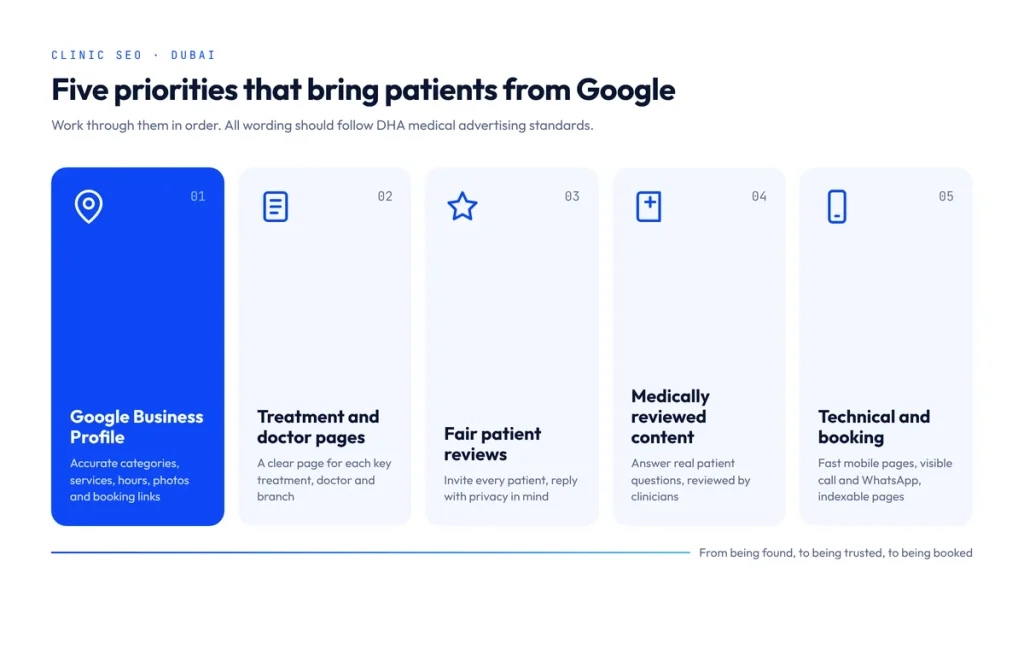
Step 1: Make your Google Business Profile genuinely useful
Your Google Business Profile is often the first place a potential patient sees your address, opening hours and reviews. Treat it as a maintained source of business information, not an occasional marketing task.
Choose accurate categories: Use the most relevant primary category for the clinic and secondary categories only where they accurately reflect offered services.
Describe real services: Add treatments the clinic actually offers, using the same plain-language names people recognise on the website.
Keep key details current: Check the address, telephone number, website, working hours and holiday updates. Make it easy for someone to find the correct branch.
Use relevant photos: Show the entrance, reception, facilities and team where consent and clinic policies allow. Avoid misleading stock images presented as your location.
Check available contact options: Add a booking link where supported. Some verified profiles can offer WhatsApp or text messaging in eligible regions; do not assume the feature is available to every clinic.
Publish updates when useful: Share relevant service or facility updates when there is something accurate to communicate. Posting every week is not a documented ranking requirement.
Practical check: ask someone unfamiliar with the clinic to find its correct branch, opening time and way to book in less than a minute. If the details are confusing, fix them before chasing new keywords.
Step 2: Give each important treatment, doctor and branch a clear page
A broad Services page is useful for navigation, but a well-written treatment page can answer specific questions more thoroughly. Start with treatments that matter commercially and have genuinely distinct information; avoid creating near-identical pages for every slight keyword variation.
An effective treatment page should tell the reader:
What the treatment involves and which questions to discuss with a clinician
What happens at an initial appointment and how patients can prepare
Important limitations, risks or aftercare considerations where relevant
Which qualified professionals provide the service, with links to their profiles
Practical information such as branch availability, insurance and published pricing
How to request an appointment by phone, approved messaging channel or secure form
Doctor profiles can introduce verified qualifications, professional registration details where appropriate, specialities, languages, and the clinics in which the doctor practises. Keep profiles accurate, up to date and approved by the relevant team.
If the clinic has several physical locations, give each real branch a useful location page with its correct address, directions, accessibility information, hours and relevant services. Avoid doorway pages that differ only by a location name.
Step 3: Ask for honest reviews—without filtering who gets asked
Reviews help a person assess whether a clinic may be suitable and can contribute to prominence in local results. The goal is a trustworthy collection of real experiences, not an artificially perfect rating.
Invite feedback fairly: After visits, use a consistent, voluntary process to invite genuine reviews from patients regardless of whether their experience was positive or negative.
Remove pressure: Do not require patients to review while staff are watching, set rating targets for employees or offer rewards for reviews.
Respond with privacy in mind: Acknowledge concerns politely and direct sensitive matters to a private channel. Do not confirm someone is a patient or disclose treatment details in public.
Learn from recurring feedback: Watch for repeated comments about scheduling, directions or communication and address service problems rather than arguing with reviewers.
Google prohibits incentives and selectively requesting positive reviews. Check the clinic’s privacy and patient communication obligations before using WhatsApp, SMS or email for review requests.
Source: Google — Prohibited and restricted content for Business Profiles
Step 4: Publish content patients can rely on
Useful articles answer real questions heard by reception teams and clinicians. Examples include what to ask at a first physiotherapy appointment, how a consultation for laser hair removal is typically assessed, or which factors can affect the cost of dental implants in Dubai.
Medical content deserves additional care because readers may act on what they read. Have an appropriately qualified healthcare professional review clinical explanations before publication. Identify the reviewer and their relevant credentials, cite suitable sources, and revisit pages when advice or clinic practices change.
Prioritise accurate, original explanations that genuinely help the reader. Thin AI-generated articles, invented patient stories and dramatic claims about outcomes create risks for both trust and quality. One carefully researched page is more valuable than many interchangeable posts.
Further reading: Google Search Central — Creating helpful, reliable, people-first content
Step 5: Remove technical and booking friction
Even strong local visibility loses value when patients reach an outdated, slow or confusing website. Give the technical and conversion basics the same attention as keywords.
Mobile experience: Check real devices and mobile connections. Compress images, avoid unnecessary scripts and make core content readable without awkward zooming.
Clear next action: Offer a visible call or appointment button on the relevant page. Make the destination clear and measure clicks without treating every click as a confirmed booking.
Indexable, distinct pages: Check that important pages can be crawled and indexed, use descriptive titles, and prevent accidental noindex or incorrect canonical settings.
Appropriate structured data: On the clinic’s own website, use applicable structured data for the organisation, location or medical professionals when it truthfully matches visible information; do not assume markup guarantees rich results.
Security and privacy: Use HTTPS, collect only necessary information in forms, and have the clinic review consent, retention and privacy notices for its legal obligations.
Arabic and English SEO for Dubai clinics
Dubai serves patients who search in different languages. A clinic may need English and Arabic treatment, doctor or location pages—but the decision should follow the audience, available clinical reviewers and search data, not a rule that every page must be translated.
When both language versions exist, translate the substance of the page, not only the menu. Use clear language-specific URLs, consistent contact details and appropriate hreflang annotations that link each version to its alternatives. Avoid creating machine-translated medical advice without a qualified language and clinical review.
Technical guidance: Google Search Central — Tell Google about localized versions of your page
Keep clinic marketing aligned with DHA advertising requirements
Healthcare marketing needs more care than ordinary retail advertising. The Dubai Health Authority (DHA) has published Standards for Medical Advertisement Content on Social Media, including restrictions involving unrealistic treatment claims, guarantees of recovery, misleading comparisons, identifiable patient information and testimonials without written consent.
The referenced standard is Version 1.1 (issued August 2022). DHA also published a circular about these social-media standards on 17 August 2026. These sources specifically address social-media medical advertising; whether and how additional rules apply to a particular website, listing or campaign should be checked with the clinic’s medical director or compliance adviser rather than assumed from this article.
A safer editorial approach is to explain who may be suitable for a consultation, how a service works and what questions to ask—not to promise “guaranteed success”, “100% results”, “no side effects” or a universal outcome. Obtain appropriate approvals for any patient photographs or stories.
Official references: DHA social-media advertising standards (PDF) | DHA circular dated 17 August 2026
A practical 30-day clinic SEO action plan
A first month should create a reliable baseline and fix obvious gaps. It is not a promise that rankings or bookings will increase within 30 days.
| Week | Priority work | Deliverable |
|---|---|---|
| Week 1 | Audit the Google Business Profile, branch data, booking routes and existing Search Console data. | Baseline dashboard and issues list |
| Week 2 | Improve the highest-value service page and key doctor or location profiles. | One fully reviewed, useful content cluster |
| Week 3 | Introduce fair review invitations and publish one medically reviewed patient resource. | Documented review process and quality content |
| Week 4 | Check mobile performance, form tracking, calls and internal links; compare data with the baseline. | Priority fixes and the next 60-day plan |
How to measure whether clinic SEO is working
Traffic alone does not tell you whether patients are discovering the right service. Agree on a small set of indicators before making changes, then review the trend regularly.
| Source | What to monitor |
|---|---|
| Google Business Profile | Profile views and available interaction metrics such as calls, directions and website visits |
| Google Search Console | Search impressions, clicks, queries and indexing for treatment and location pages |
| Website analytics | Appointment-form completions, click-to-call events and WhatsApp link clicks |
| Reception or CRM | Confirmed new-patient enquiries and the patient-reported discovery channel |
Where possible, connect enquiries with actual booked appointments while respecting patient privacy. A click on WhatsApp is an intent signal, not proof of a patient booking. Compare results with seasonality, changes in ad spend and any service availability limits.
How long does clinic SEO in Dubai take?
Some corrections, such as inaccurate opening hours or broken booking links, can improve the experience immediately. Search visibility and competitive treatment terms are less predictable. Depending on the site’s starting position, the specialty and the competition, meaningful organic changes may take months. A three-to-six-month review window can be useful for planning, but it is not a ranking guarantee.
The strongest approach is continuous improvement: check what patients search for, publish genuinely useful pages, remove friction and use enquiry data to guide the next priority.
How Blue Tech helps clinics grow
Blue Tech brings website design, SEO, content planning and digital marketing into a coordinated approach. For healthcare providers, that can mean clearer service pages, reliable doctor and location information, a better enquiry flow and measurable local-search work—all subject to the clinic’s content and compliance approvals.
Our experience with healthcare-related digital projects includes work connected with Injurease, an injury-recovery provider in Sydney.
Explore our Healthcare & Beauty solutions and SEO optimization service to see how our team approaches website and search visibility projects. Planning a new clinic website first? Read our guide to business website costs in the UAE.
Want to understand why patients are not finding your clinic on Google? Start with a practical review of your Google visibility, key treatment pages and booking experience. Contact Blue Tech to discuss your clinic’s priorities.
Frequently asked questions
How can my clinic get more patients from Google in Dubai?
Start by making your Google Business Profile accurate, improving your most important treatment and doctor pages, requesting genuine reviews fairly, and simplifying the mobile appointment experience. Track confirmed enquiries rather than relying only on ranking reports.
Is Google Business Profile more important than a clinic website?
Both play different roles. Google Business Profile helps people discover and contact a physical location; the website gives more room for treatment information, doctors, branch details and appointment steps. The priority depends on current gaps and search demand.
Does every treatment need a separate page?
Not automatically. Important treatments with distinct patient questions usually deserve useful individual pages. Related services that do not justify separate content can be grouped to avoid repetitive or thin pages.
Should Dubai clinics publish content in Arabic and English?
If both languages serve the clinic’s audience and the team can maintain accurate content, separate language versions can improve usability. Ensure full translations, medical review and appropriate technical signals such as hreflang.
How should a clinic respond to a negative Google review?
Respond calmly without confirming patient status or discussing health information. Offer an appropriate private contact channel for sensitive details and use repeated feedback to identify service issues.
Can clinics promise results or call themselves the best?
Unsubstantiated or absolute medical advertising claims create regulatory and trust risks. DHA’s social-media advertising standard restricts misleading assurances and related claims; have each campaign and channel checked against the rules that apply to the facility.

