
Blog
How to Get Your Business Recommended by ChatGPT and Google AI in the UAE (2026 Guide)

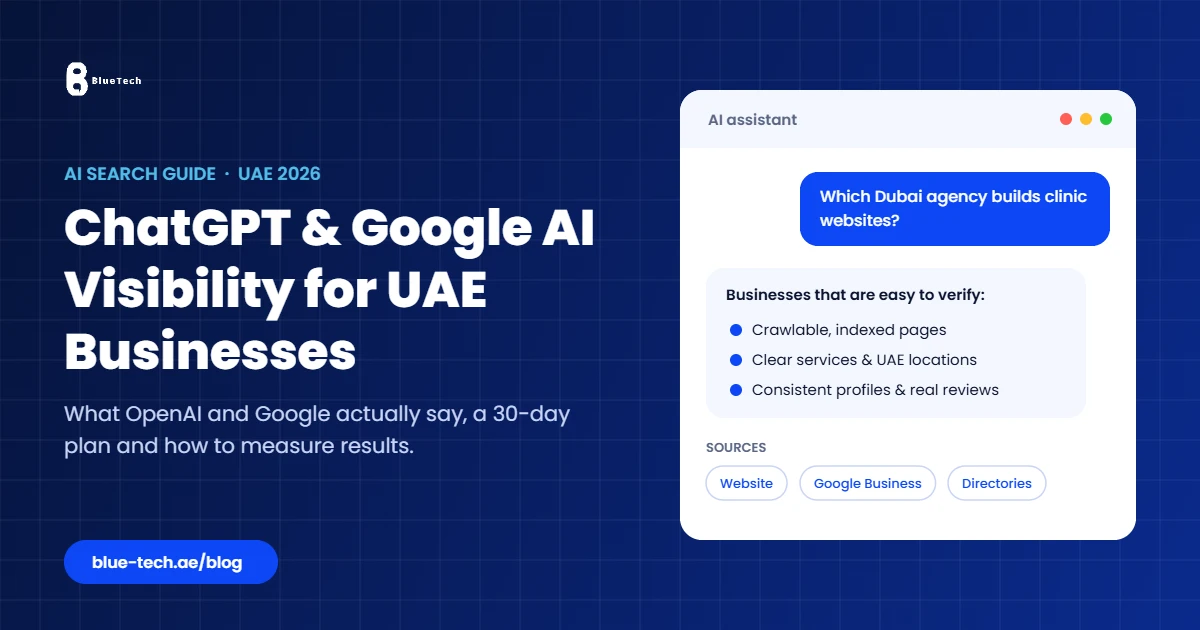
When someone asks an AI assistant, “Which Dubai agency builds clinic websites?” or “Who supplies corporate gifts in the UAE?”, the answer may mention a few businesses and link to supporting sources. That gives companies a new discovery opportunity, but no business can force an assistant to recommend it.
This guide separates what OpenAI and Google actually document from practical marketing recommendations. You’ll learn how to make your business easier to discover, how to avoid misleading “AI ranking” shortcuts, and how to measure visibility without confusing an AI mention with a paying customer.
Quick answer: how do businesses become easier to recommend?
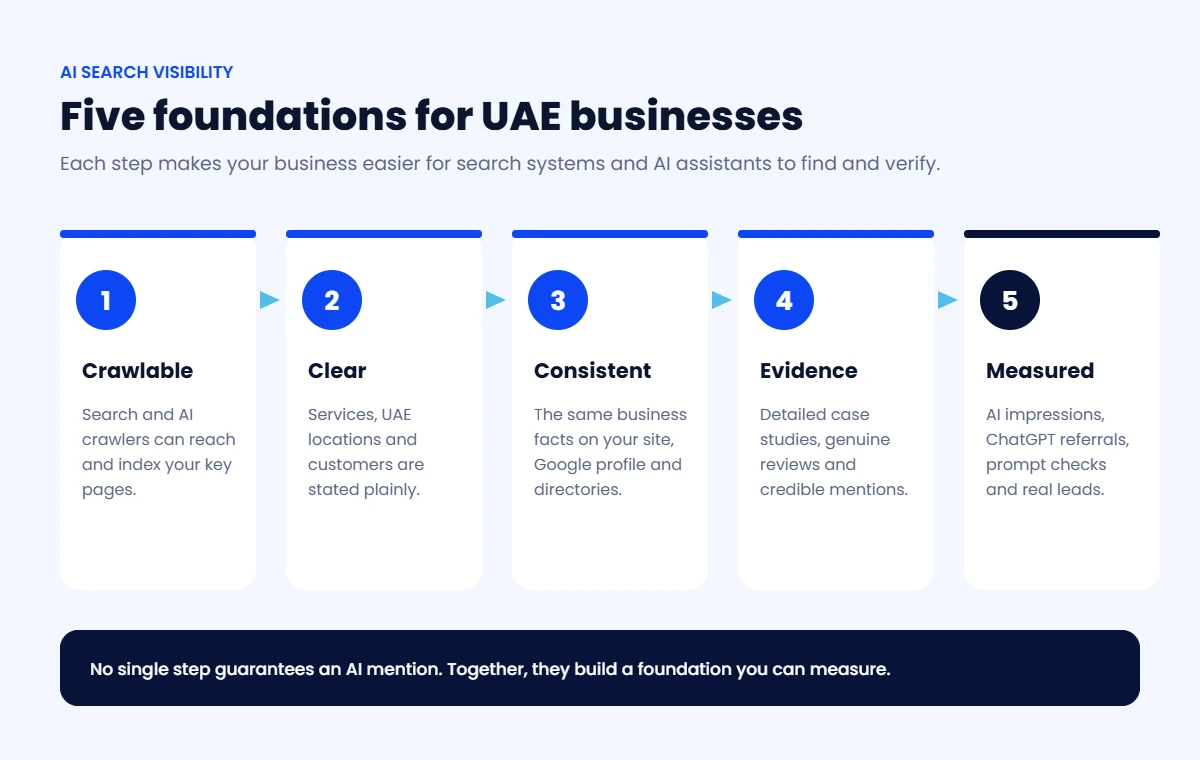
Make your business easy to access, accurately describe and independently verify. Keep important pages crawlable; explain your services, locations and audience in plain language; publish useful evidence; and maintain accurate profiles across the web. These actions improve your digital foundation, but they do not guarantee that ChatGPT, Google AI Overviews or AI Mode will mention you.
| Focus | What to do | What it can help with |
|---|---|---|
| Accessibility | Check indexing, crawl permissions and firewall rules. | Eligibility for discovery, not guaranteed inclusion |
| Clarity | Explain services, customers, UAE locations and pricing context. | Better understanding by visitors and search systems |
| Consistency | Update business details across owned and third-party profiles. | Less confusion about identity and contact details |
| Evidence | Show detailed projects, relevant credentials and genuine feedback. | Stronger information for people to assess |
| Measurement | Track AI-feature impressions, referrals and qualified enquiries. | Business decisions grounded in observed results |
Why AI search visibility matters in the UAE
The shift is worth taking seriously, but its scale needs careful interpretation. Adyen’s UAE Retail Report 2025 was reported as finding that 70% of UAE consumers had used AI tools while shopping. That is a shopping-use statistic, not proof that 70% ask ChatGPT to recommend local companies.
In August 2026, Salesforce research reported that 62% of surveyed UAE businesses had created or optimised content for conversational, question-based searches, while 31% monitored how their brands appeared in AI-generated responses. These findings suggest an opportunity for disciplined measurement rather than simply publishing more content.
Read the Adyen research coverage · Salesforce UAE findings
What OpenAI and Google actually say
ChatGPT search: access and relevance, not a paid organic ranking
OpenAI documents OAI-SearchBot as the crawler used to surface websites in ChatGPT search. A website owner can allow this bot for search while separately blocking GPTBot, which relates to model training. Check both robots.txt and any CDN or firewall restrictions. Allowing OAI-SearchBot helps make a site eligible to be found; it does not promise inclusion in an answer.
OpenAI also runs sponsored advertisements in ChatGPT in supported experiences. These ads are clearly labelled and separate from assistant-generated answers. Paying for an ad does not change the assistant’s organic recommendations.
OpenAI crawler documentation · OpenAI: Ads in ChatGPT
Google AI Overviews and AI Mode: the SEO foundation still applies
Google says there are no special optimisation requirements for AI Overviews or AI Mode beyond the usual Search requirements. To be eligible as a supporting link, a page must be indexed and eligible to appear in Google Search with a snippet. Useful content, internal links, readable page text, good page experience and accurate structured data remain important SEO practices; none guarantees an AI citation.
Google also says you do not need an llms.txt file or “AI-only” schema markup to appear in these features. Accurate Business Profiles and Merchant Center data can support appropriate local or product experiences, where relevant to the business.
Google: AI features and your website · Google: Generative AI optimisation guide
SEO vs AEO vs GEO: what is the difference?
| Term | Practical meaning | Important caveat |
|---|---|---|
| SEO | Improve discovery, usefulness and performance in search engines. | A foundational discipline, not a guarantee of ranking. |
| AEO | Structure useful answers to questions people actually ask. | A common marketing label, not a separate official ranking system. |
| GEO | Work on clarity and evidence relevant to generative answer experiences. | No universal “GEO score” or guaranteed AI placement exists. |
For most UAE businesses, start with strong SEO and excellent service pages. Then measure how AI-powered discovery behaves, rather than buying a separate “AI hack” package.
Seven practical steps for UAE businesses
1. Make important pages accessible
Check robots.txt, noindex rules, canonical tags, redirects and indexing status in Google Search Console. For ChatGPT search, confirm OAI-SearchBot is allowed and not blocked by WAF, bot protection or host rules. In Search Console, also confirm your site isn’t excluded from Search generative AI features. An XML sitemap helps discovery, but listing a URL does not guarantee indexation.
2. State exactly who you help, and where
Replace vague descriptions such as “innovative digital solutions” with specific service pages: “clinic website development in Dubai”, “custom logistics platform for UAE distributors” or “WooCommerce stores with WhatsApp ordering”. Explain deliverables, service areas, who the solution fits and the next step to enquire.
3. Keep business facts accurate across profiles
Check your website footer, contact page, Google Business Profile (if eligible), LinkedIn and relevant business directories. Keep genuine business names, operating locations, telephone numbers, hours and services accurate. Do not create fictional locations or duplicate business profiles to chase extra visibility.
4. Publish independent, verifiable evidence
Useful evidence may include genuine client reviews, industry memberships, relevant partner pages and credible third-party mentions. These can help prospective customers validate a company, but no public source provides a universal formula proving they receive a particular weight in every AI assistant.
5. Answer buying questions with original detail
Create pages that address real sales questions: what a service includes, typical timelines, what changes the budget, which integrations matter, and whether support is included. Use accurate UAE examples and disclose when prices are starting rates rather than fixed package prices. Translate high-value pages into Arabic when your audience searches in Arabic; keep both versions consistent.
6. Use structured data accurately
Appropriate Organization, LocalBusiness (when eligible), Article and Breadcrumb structured data can support standard search understanding and eligible rich results. Match it to what visitors can actually see on the page. There is no special schema tag that makes an AI assistant choose your brand.
7. Turn portfolio items into useful case studies
Describe the client sector, starting problem, business requirements, solution, integrations and evidence of outcomes where approved. A case study showing a real workflow is more useful to a buyer than an unqualified claim of being the “best agency in Dubai”. Never invent success metrics or imply that a project ranked in ChatGPT without a documented test.
A 30-day AI search visibility action plan
| When | Priority work | Deliverable |
|---|---|---|
| Week 1 | Crawlability, indexing, analytics and business-fact audit | Issue list with owners and fixes |
| Week 2 | Improve 2–3 core service/location pages and relevant internal links | Clear, conversion-ready pages |
| Week 3 | Publish one evidence-led case study and update legitimate profiles | Verifiable proof and consistent profiles |
| Week 4 | Run repeatable AI prompts, inspect Google AI reports and audit leads | Baseline dashboard and next-month priorities |
Treat this as an implementation plan, not a promise that AI mentions or leads will rise within 30 days. Crawl, indexing and third-party data changes may take longer to be reflected in AI-generated results.
How to measure whether AI is recommending your business
Do not report a single “AI ranking”. Combine multiple imperfect signals, then connect them to enquiries and revenue.
- Google Search Console: use the Generative AI performance report to review which URLs earned impressions in Google’s generative AI features, the countries and devices involved, and changes over time. Google rolled out this report worldwide by 31 August 2026. The report currently shows impressions only, not clicks, and an impression means exposure, not a recommendation or conversion.
- ChatGPT referrals: in GA4, review relevant referral sources and tagged inbound links, including chatgpt.com where available. Distinguish genuine sessions and form submissions from simple brand mentions. Referral reporting cannot show every response that mentioned you.
- Controlled prompt checks: build a fixed list of buyer questions in Arabic and English. Keep location, platform, account state and testing method as consistent as possible. Record whether your business was mentioned, linked, genuinely recommended or not shown, along with the sources presented. Repeat over time because outputs vary.
- Lead attribution: ask qualified prospects “How did you first hear about us?” Include ChatGPT, Google AI, regular Google Search and referrals. Then track proposals, won deals and values, not only clicks.
| Metric | What it tells you | What it does NOT prove |
|---|---|---|
| AI feature impressions | Your URL was shown within Google’s generative AI features. | That a buyer chose your business. |
| Brand mention / citation | Your company appeared in a sampled AI response. | Stable ranking across users or prompts. |
| ChatGPT referral session | A visit arrived from an identifiable ChatGPT link. | Every AI-sourced lead or offline contact. |
| Qualified enquiry / sale | A real business outcome attributable to a lead. | That AI was the only influence in the sale. |
Google: Search Generative AI reports launch and worldwide rollout
A real-world perspective: how Blue Tech approaches its own visibility
At Blue Tech, our content strategy is built around buyer questions that arise during project discussions: website budgets in the UAE, WordPress versus custom development, clinic search visibility, mobile-app costs and WhatsApp ordering for online stores. These topics allow potential clients to evaluate a specific need before contacting an agency.
We also connect relevant guidance to our service pages and use genuine project descriptions where the client has approved publication. That creates a clearer path from a question to a solution and then to an enquiry. These are the practices we can describe; we are not claiming that ChatGPT currently recommends Blue Tech at a certain position or that a particular number of pages was indexed because of this work.
Our measurement priorities are the same ones we recommend to clients: verified Search Console data, consistent AI prompt testing, qualified leads and actual business outcomes. Any numerical improvement in indexation should only be published alongside dated evidence and appropriate context.
Explore Blue Tech SEO services
Mistakes and promises to avoid
- Guaranteed ChatGPT recommendations or a guaranteed Google AI citation: neither platform promises inclusion for a specific business.
- Treating sponsored ads as organic endorsements: paid placements are separate from assistant-generated answers.
- Buying fake reviews or irrelevant directory mentions: accuracy and relevance matter more than volume.
- Installing llms.txt or unusual schema as a shortcut: Google does not require these for AI Overviews or AI Mode.
- Misreading the data: a Search Console impression is not a confirmed lead, and one prompt test does not represent every user.
Frequently asked questions
Can I pay ChatGPT to recommend my company?
You can advertise in supported ChatGPT placements, but advertisements are labelled and separate from answers. Paying for an ad does not determine whether the assistant organically recommends your business.
Do I need an llms.txt file?
Not for Google AI Overviews or AI Mode. Google’s documentation says Google Search does not use llms.txt as a special ranking or visibility mechanism. Other systems may treat that file differently, so do not regard it as a universal requirement or solution.
How do I appear in Google AI Overviews?
Follow Google’s normal Search technical and content requirements. Publish helpful, well-structured pages that are eligible for indexing and snippets. Being eligible does not ensure Google will select or link to a page in an AI feature.
Can I monitor Google AI visibility in Search Console?
Yes. Google’s Generative AI performance reports show visibility metrics, including impressions and pages, for relevant AI features. Combine them with standard Search Performance and GA4 conversion data rather than treating impressions as enquiries.
Does having Arabic pages help a UAE business?
Arabic content can serve customers who search and evaluate services in Arabic. Use accurate translations, useful local details, and correct multilingual technical setup where appropriate. Publishing Arabic pages alone does not guarantee AI mentions.
How long does AI visibility optimisation take?
Technical issues may be fixed quickly, but content quality, crawling, external mentions and business outcomes are longer-term work. Set a baseline now, then review evidence monthly instead of promising a fixed ranking deadline.
Want to know how AI search sees your business?
Blue Tech can review your public website, business information and a defined sample of AI search results, then identify practical gaps and priorities. The aim is to make your business easier to discover and evaluate, not to promise a guaranteed recommendation.
Request a free AI visibility check. Share your website and your main UAE market on WhatsApp. We will outline the next practical steps for your business.
Explore Blue Tech SEO services
Sources and further reading
- OpenAI: Overview of OpenAI crawlers
- OpenAI: Ads in ChatGPT
- Google Search Central: AI features and your website
- Google Search Central: Guide to generative AI optimisation
- Google Search Central: Generative AI performance reports (2026)
- Adyen UAE Retail Report 2025: Khaleej Times coverage
- Salesforce UAE State of Commerce 2026: Khaleej Times coverage


